Built for African Clinical Practice

Not sure what to do next?

Get a structured clinical plan in under 2 minutes.

You have 30 patients waiting, and zero room for mistakes

The clinician's problem isn't knowledge. It's having time to think through every case systematically.

Diagnostic momentum

You anchor on the first diagnosis that comes to mind. Must-not-miss conditions stay unexamined.

Missed disposition

Critical decisions are easy to overlook on busy shifts.

Facility limitations

Management plans often drift toward what teaching hospitals can do — not what your facility can do today.

Sample scenario

Saturday OPD. Patient 18 of 30. Dyspnoeic. SpO₂ 89%. No consultant available. You need differentials, investigations, and a clear disposition plan before the next patient walks in.

Hypoxic CAP in less than 2 minutes.

Case input

45F · cough · fever · SOB · chest pain · 4 days · 76 kg · District

SpO₂ 89% HR 105 RR 24 BP 125/78 Temp 37.7°C

Clinical Impression

Severe community-acquired pneumonia with hypoxaemia; consider COVID-19.

Must-not-miss

Pulmonary embolism Acute heart failure Pneumothorax Sepsis

Acuity · Emergency

Red Flags

SpO₂ ≤90% on room air · increasing work of breathing · accessory muscle use · hypotension · altered mental status · pleuritic chest pain with haemoptysis and tachycardia (possible PE).

Management & Disposition

Oxygen titrated to SpO₂ 92–96% · IV access and cultures · Ceftriaxone 2 g IV daily · Azithromycin 500 mg daily × 3 days · Paracetamol 1 g every 6–8 hours PRN.

Disposition ICU

Investigations (District tier)

Pulse oximetry continuous (target SpO₂ 92–96%) · FBC · U&E/Cr · CRP · blood cultures ×1–2 before antibiotics · malaria RDT · chest X-ray PA/AP portable urgently · ECG.

What Would Change This Assessment

Positive D-dimer or leg USS → escalate PE workup · CXR showing pneumothorax → immediate chest drain pathway · worsening hypotension or lactate → sepsis/ICU escalation · pleuritic pain + tachycardia with normal CXR → consider PE workup.

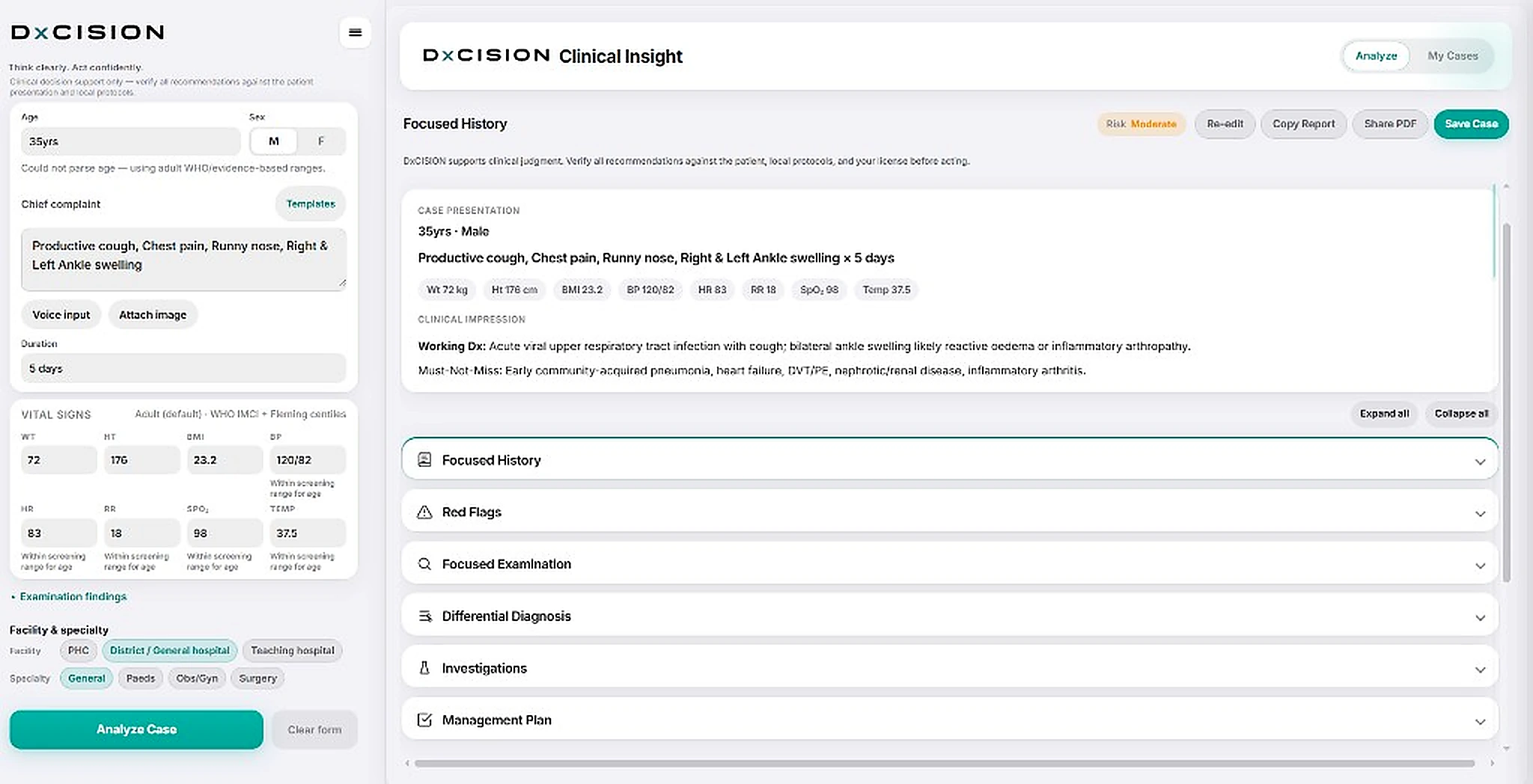
Enter the case. Get a structured Consultant-style assessment.

Complaint + vitals → DDx, tests, disposition. After your exam — not instead of it.

Tap a step to explore

45
Female
Cough, Fever, Shortness of breath, Fast breathing, Chest pain × 4 days
Facility District
Mode Emergency

Orders that match your facility

Recommended investigations and management options adapt to your current healthcare facility.

Tap PHC, District, or Tertiary to compare

Investigations matched to your facility

5 investigations recommended for Primary Health Centre

African formulary dosing

Route, dose, and duration for drugs you can prescribe today.

Local epidemiology built in

Malaria, HIV, TB, and IMCI danger signs — not Western-default prevalence alone.

ChatGPT helps you explore. UpToDate helps you reference. DxCISION helps you decide.

Designed for the reality of busy clinics, limited resources, and high patient volumes.

ChatGPT UpToDate / references DxCISION
Your patient data grounds output Sometimes No Yes
Consistent clinical workflow for every case No No Yes
Facility tier shapes investigations No Partial Yes
Clear next-step recommendation every case No No Yes
Built exclusively for licensed clinicians No Varies Yes
African formulary & dosing Inconsistent Western-default Yes
Warns if output cites vitals you did not enter No N/A Yes

Keep UpToDate, ChatGPT, and Open Evidence for in-depth studying. Use DxCISION when a patient is waiting.

Free during early access.

MDCN folio in. Start your first case today.

Early Access

Clinician Access

For MDCN clinicians — OPD, casualty, district, and teaching centres.

  • Ranked DDx, red flags, disposition every case
  • Emergency ABC + full workup
  • Save cases · copy for handover
  • Investigations by facility tier
Sign up free with MDCN folio →

Free · MDCN required · No payment yet

Questions clinicians ask

You are. Decision support only — your exam and judgment stay final. Verify before acting.
Yes. It won't invent vitals or findings you didn't enter. Warnings flag mismatches — vitals you never typed, paeds dosing without weight, risky doses.
You verify it — against your exam, the patient in front of you, and local protocols. The plan is built from what you entered; warnings flag invented vitals or dose issues; every case includes what would change the assessment if new findings emerge.
ChatGPT explores — it doesn't force ranked DDx, must-not-miss checks, facility-matched tests, and disposition every case. Google gives fragments. UpToDate helps you reference — DxCISION structures the patient in your queue.
Most cases: ~2 minutes intake to assessment. Use between patients, after your exam — not instead of it.
Yes. Pick your facility tier at intake — investigations and plans match what you can order today, including local epidemiology, not a teaching-hospital wish list.
Register with MDCN folio → enter presentation, facility tier, mode, vitals → Analyze. First assessment — impression through disposition — in ~2 minutes.
Fully free during early access — all core assessments available now. MDCN-registered clinicians only. Sign up with folio (MDCN/R/######), email, and password.

Patient 18 is already in the corridor.

See the hypoxic CAP example, then sign up and run your next difficult case.